

Vranduk, Maglaj and Doboj on the Bosna river
Three fortresses in the Bosna valley stood beside routes used by traders, townspeople and armies. Their histories extend into the settlements and approaches below the walls.
Doboj · Bosna valley · 13th c. onward
Doboj’s Gradina is a repeatedly rebuilt fortification whose early history is studied through objects, documents and images.
Known locally as Gradina, Doboj's fortress forms the historic skyline above the modern city and Bosna valley. The Republika Srpska tourism organisation attributes the beginning of stone construction to the thirteenth century, drawing on archaeological discoveries and later documentary evidence. Its masonry belongs to repeated phases of conflict, repair and adaptation, rather than a single medieval building campaign. The elevated position helps explain its strategic importance on the river corridor. Surviving towers, enclosing walls and later restoration need to be distinguished when a detailed model is prepared.
Explore the 3D model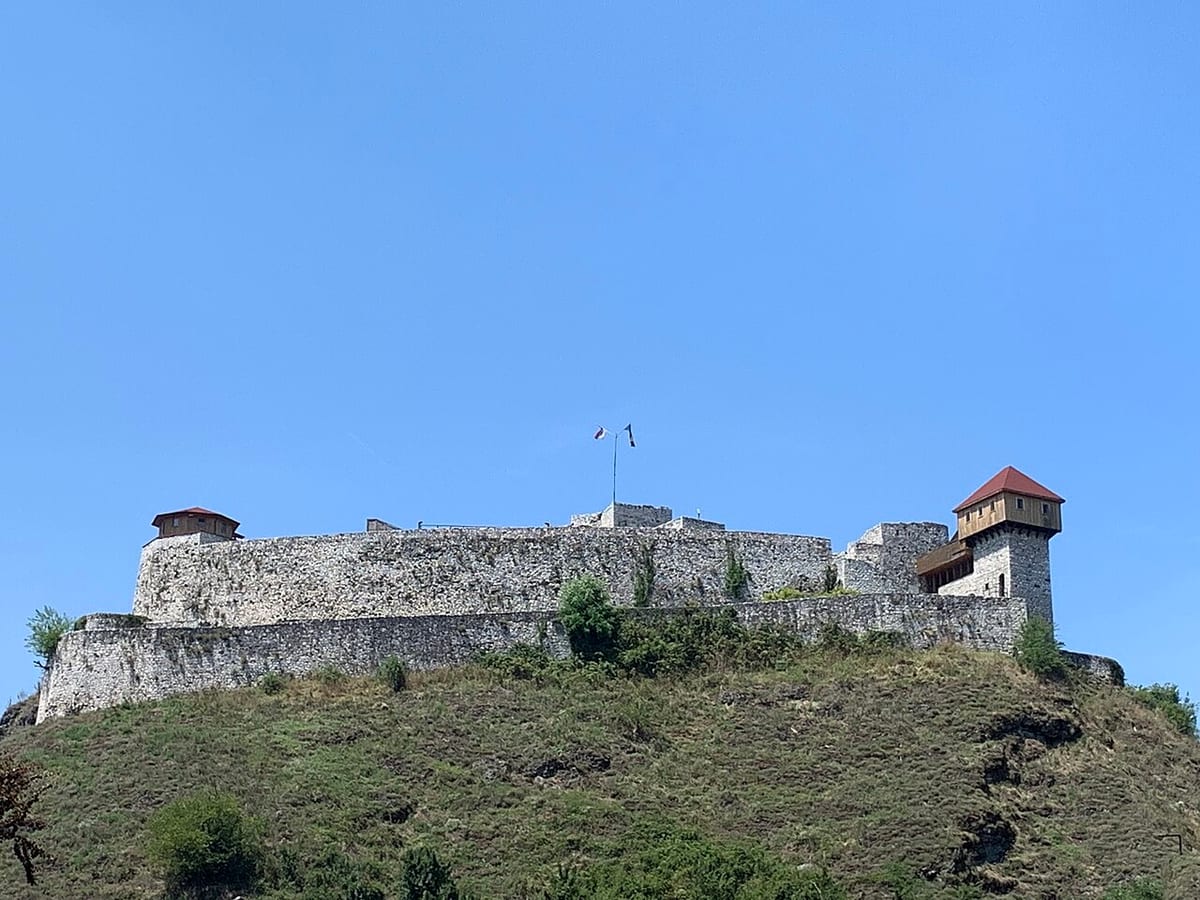
The tourism organisation’s account cites pottery from the southern tower, jewellery from the Usora cemetery, Ottoman registers and Austrian engravings from 1697. These are different kinds of evidence: finds illuminate occupation, while records and pictures help trace later military use.
The same account describes repeated enlargement and repair as garrisons changed. A thirteenth-century beginning for stone construction does not make every visible feature thirteenth-century. Doboj is best read as a sequence of building campaigns.
Doboj’s municipal history interprets the settlement below the fortress through its roads. It describes a market space where routes met near the entrance, with streets and houses developing around that junction. This is an explanation of how defence and commerce could reinforce each other: controlling movement mattered, but travellers and goods also sustained the settlement. The account stresses how strongly the terrain shaped the layout. Look beyond the tower silhouette towards the saddle and the Bosna valley when considering the castle’s position; the protected approach was part of an inhabited town.
Archaeological evidence places the beginning of stone fortification in this period.
Military use brings repeated repair and enlargement.
The entrance complex is a recognizable feature of Gradina. Its roofed tower and open passage are represented approximately; restored fabric is not presented as untouched medieval masonry.
The fortress follows a triangular hilltop plan. A raised interior and rounded southern defensive work express its adaptation to the rock and later military use.
The broad northern end contains defensive works adapted for artillery. This open polygonal platform indicates that role without inventing cannon replicas or a historical garrison.
The fortress is approached uphill from Doboj. Consult the local tourism organisation for current opening arrangements.
Get directionsA first written mention is not necessarily a construction date. Fortresses were often altered over several centuries. Sections link to their supporting references; the 3D model is an interpretation, not evidence of every historical phase.
Three fortresses in the Bosna valley stood beside routes used by traders, townspeople and armies. Their histories extend into the settlements and approaches below the walls.
Tešanj · Usora
Gračanica · Trebava foothills
Maglaj · Bosna Valley