
Dating Srebrenik and Tešanj: what the written records tell us
Srebrenik appears in a charter from 1333; Tešanj has two well-known references from 1461. Neither date establishes when all the buildings now standing were constructed.
Tešanj · Usora · Documented 1461
Tešanj’s Gradina contains distinct upper and lower defences, now interpreted through the local museum.
Tešanj's fortress rises on a steep hill above the town. It belonged to the historical region of Usora and watched routes linking the Bosna valley with northern communications. Its medieval history is less securely known than the scale of the surviving walls might suggest. The Museum of the Bosnian Kingdom identifies two written references from 1461, including a royal grant to Prince Radivoj, while warning against confidently equating Tešanj with much earlier place names. Control shifted amid Ottoman and Hungarian rivalry before Ottoman authority was established in 1512. The upper and lower parts preserve different building phases, with Ottoman work strongly shaping the present appearance. This is therefore a layered defensive complex, rather than a castle whose entire fabric can be assigned to one medieval ruler.
Explore the 3D model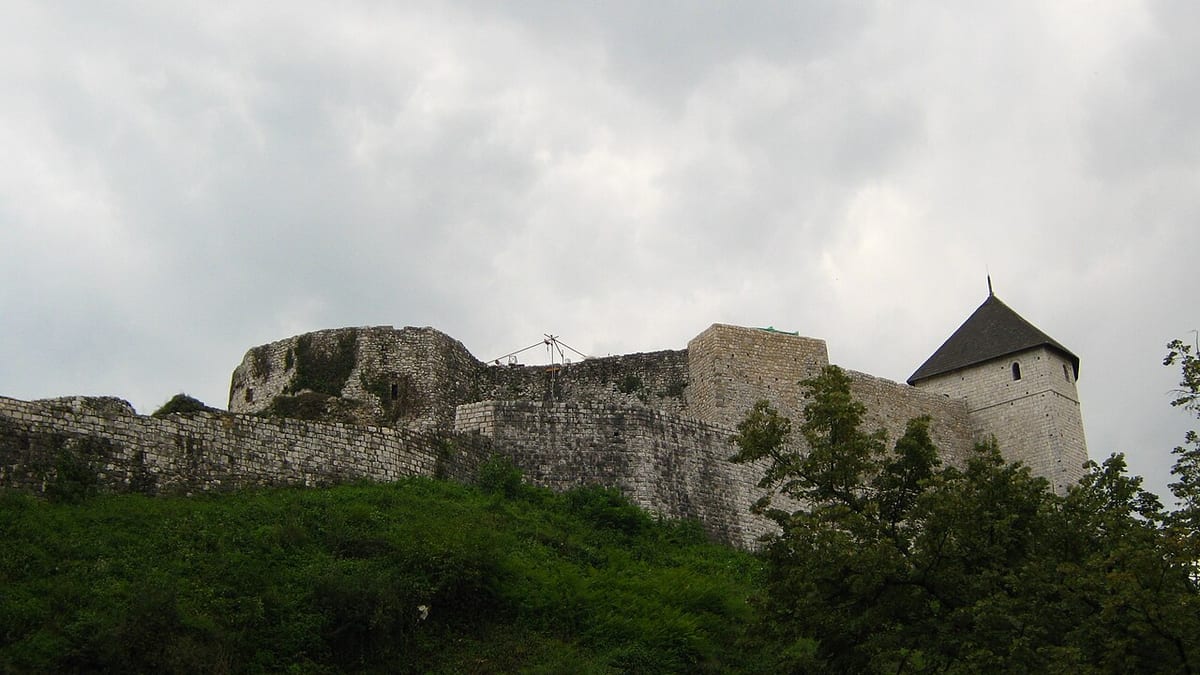
The museum describes Ottoman gun platforms covering the main approach, including a position with a casemate. Dizdar’s Tower in the lower enclosure had a ground floor and two upper floors. These additions show adaptation to firearms rather than the survival of an unchanged medieval residence.
Excavations in the 1980s recovered material now exhibited in the fortress. Museum displays connect the walls with archaeology, local history and craft work. Repairs beginning in the mid-twentieth century also form part of what visitors see today.
Tešanj enters its best-known written record through two different institutions. The museum cites a papal letter of March 1461 encouraging visits to the Franciscan church of St George, followed by a royal charter of September granting Tešanj to Radivoj, the king’s uncle. These references place religious life and ownership alongside military defence. Their survival also differs: the papal letter is known through a copy, while the museum notes that the original royal charter is lost. Neither document supplies a full plan of the fortress, but together they reveal a place with significance beyond its walls.
Two surviving historical references place Tešanj in the final years of the Bosnian kingdom.
Ottoman authority replaces Hungarian control.
Conservation projects preserve the fortress fabric.
Tešanj’s upper enclosure preserves the fortified hilltop core. Polygonal towers and high curtains stand above the lower town; the dark roof follows the museum’s reference photograph.
The Ottoman tower has a ground floor and two upper storeys. Today it houses museum displays covering archaeology and the history of Tešanj.
The lower enclosure developed during Ottoman rule. Its bastions adapted the defenses for artillery and protected the approaches to the older stronghold.
The fortress is a branch of Tešanj Museum, whose visitor description includes archaeological displays and local history in Dizdareva kula. Plan to look inside the museum spaces as well as across the town from the ramparts. The museum publishes separate opening-time and price information on its website. Ask which exhibitions are accessible on your visit date through +387 32 655 770 or info@muzejtesanj.ba, especially when arranging a group visit.
Published guidance checked . Not checked on site; confirm current arrangements with the operator before travelling.A first written mention is not necessarily a construction date. Fortresses were often altered over several centuries. Sections link to their supporting references; the 3D model is an interpretation, not evidence of every historical phase.
Srebrenik appears in a charter from 1333; Tešanj has two well-known references from 1461. Neither date establishes when all the buildings now standing were constructed.
A royal portal, artillery positions and later service buildings survive within these fortresses. The structures belong to different periods of occupation and repair.
Maglaj · Bosna Valley
Doboj · Bosna valley
Gračanica · Trebava foothills