
Vranduk, Maglaj and Doboj on the Bosna river
Three fortresses in the Bosna valley stood beside routes used by traders, townspeople and armies. Their histories extend into the settlements and approaches below the walls.
Maglaj · Bosna Valley · Documented 1408
Maglaj’s walls record the transition from a medieval stronghold to an Ottoman artillery fortress.
Maglaj's stronghold rises on a prominent rock above the right bank of the Bosna, beside the slopes of Mount Ozren. Its defensive walls and towers respond to that difficult ground, giving the site a close relationship with the river corridor below. The municipality identifies a reference in King Sigismund's charter of 1408. Although its beginnings are medieval, Ottoman builders gave the fortress much of its eventual form. Later conflicts, repairs and changes of control also belong to its story. The clock tower is an especially recognizable part of the surviving ensemble. Rather than treating the site as a frozen medieval scene, it is more revealing to look for the successive ways its gates, towers and enclosures were adapted. Modern restoration has also influenced what visitors encounter.
Explore the 3D model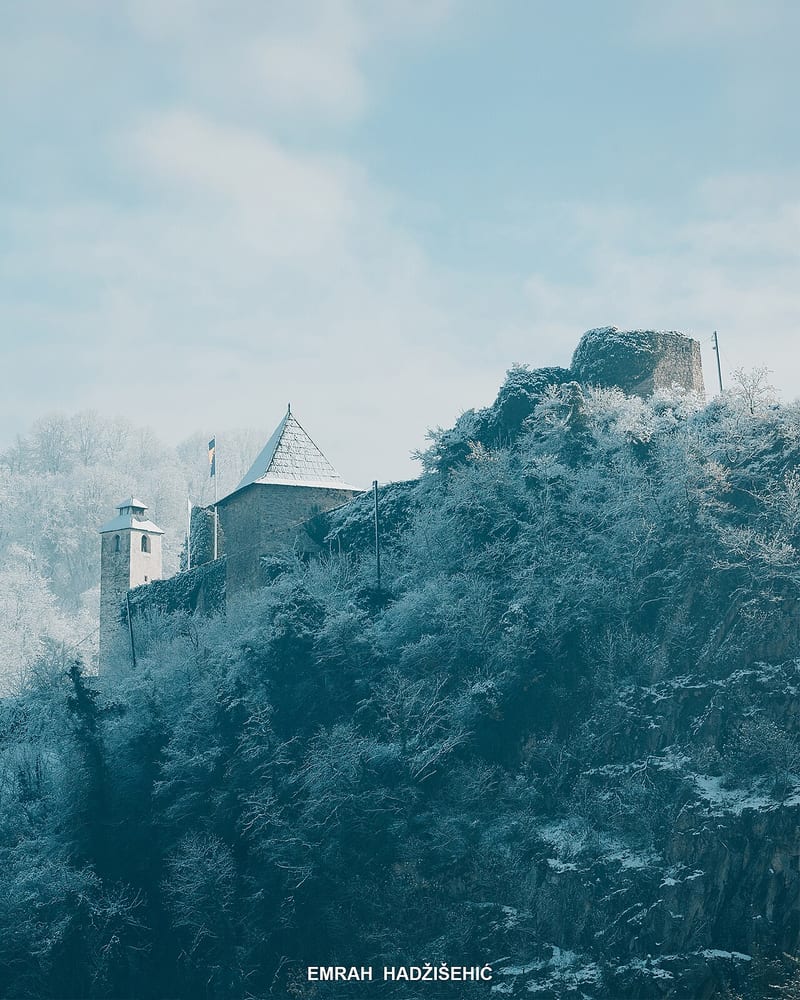
Ottoman alterations shifted the entrance from west to north. Thickened walls, cannon positions and the clock-tower courtyard changed how the enclosure worked. The two polygonal towers are unequal: one dominates the complex, while an internal wall separates the other.
The date of Ottoman capture is not securely established in this account. Maglaj appears as a nahija in the 1485 register but not in the 1468 register. Medieval ownership and the existence of an early settlement below the walls also remain incompletely documented.
Maglaj’s early written appearance is tied to Sigismund’s 1408 campaign along the Bosna valley. The museum discusses a charter issued during the king’s stay near the fortress, rather than a record of its foundation. That context helps explain both the site’s strategic position and the limits of the evidence: a visiting army could leave a dated document even where local ownership is poorly known. The steep rock above the river is therefore more than a dramatic backdrop. It is a useful starting point for understanding why this particular place entered the record of a wider conflict.
Maglaj appears by name in a charter of King Sigismund.
The fortress acquires much of its final architectural form.
Municipal records describe work on the clock tower, gates and stairs.
The clock tower belongs to the lower enclosure and is a distinctive surviving feature of Maglaj. This model uses a slender limewashed shaft and four-pitched roof; its architectural details are approximate.
The conservation account records an 8 m wide, 12 m high gate tower. Stairs connect the narrow western approach to the upper courtyard, approximately 6 m above the lower enclosure.
The medieval defensive tower was altered into a low irregular artillery bastion. The federal conservation study identifies two surviving casemates along the eastern side. This study keeps these spaces low and roofed instead of inventing a complete medieval keep.
The fortress overlooks Maglaj's old town on the Bosna. The approach climbs historic terrain; consult local visitor information for current entry conditions.
Get directionsA first written mention is not necessarily a construction date. Fortresses were often altered over several centuries. Sections link to their supporting references; the 3D model is an interpretation, not evidence of every historical phase.
Three fortresses in the Bosna valley stood beside routes used by traders, townspeople and armies. Their histories extend into the settlements and approaches below the walls.
Tešanj · Usora
Doboj · Bosna valley
Gračanica · Trebava foothills