
Medieval and Ottoman buildings at Jajce, Travnik and Tešanj
A royal portal, artillery positions and later service buildings survive within these fortresses. The structures belong to different periods of occupation and repair.
Jajce · Central Bosnia · Medieval
Jajce’s hilltop citadel is the upper part of a defensive system extending towards the Pliva and Vrbas.
High above the Pliva and Vrbas, Jajce’s fortress preserves traces of a royal Bosnian town. Its surviving portal bears the Kotromanić coat of arms; later structures tell of Ottoman and Austro-Hungarian rule.
Explore the 3D model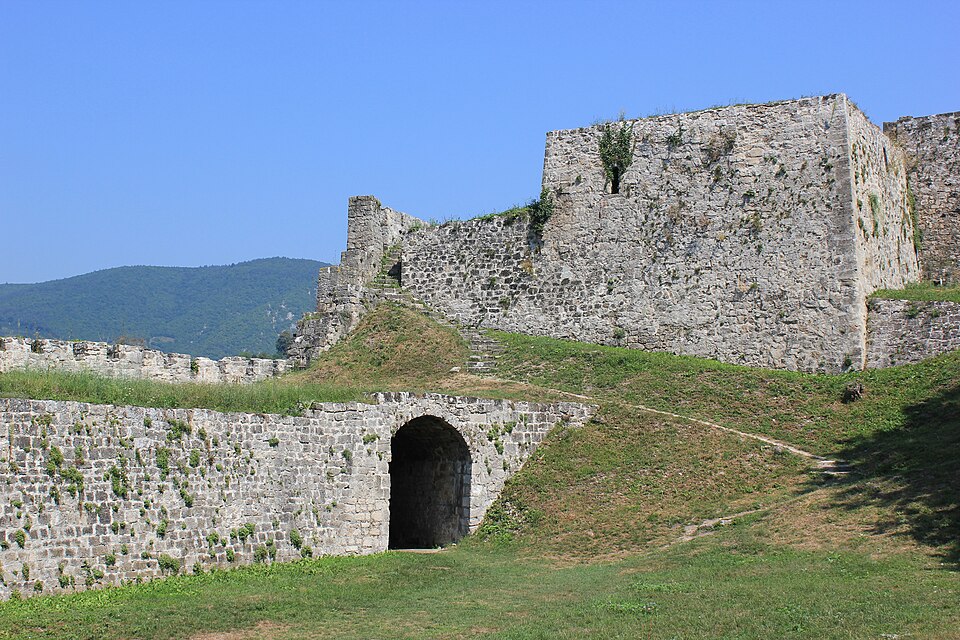
The walls continued downhill through gates, towers and artillery positions. Travnička and Banjalučka gates controlled different approaches. The building now called Sahat-kula originally served as a medieval entrance: its familiar clock-tower name describes a later chapter.
The royal portal is not the only surviving clue. A powder store dates from the late eighteenth or early nineteenth century; a water reservoir belongs to Austro-Hungarian administration. Together they show how storage and water supply prolonged the fortress’s usefulness.
Beside the present entrance, the carved Kotromanić coat of arms gives the citadel a visibly royal identity. Jajce’s heritage agency dates this portal to the fifteenth century and describes it as the country’s only surviving royal portal. Look at its position in relation to the entrance rather than expecting an intact royal palace behind it. A ceremonial doorway and a defensive enclosure served different purposes: the first announced authority, while the second protected it. This reading of the portal helps connect a small architectural detail with the much larger history of the Bosnian monarchy.
Origins possibly in the 13th century; the precise founding date is uncertain.
The royal portal becomes part of the fortress’s surviving identity.
A powder magazine and water reservoir reshape the interior.
The surviving 15th-century portal bears the Kotromanić coat of arms. This simplified opening indicates its role; carved decoration is not reproduced.
The commission records an irregular quadrilateral, a 260 m circuit and walls about 1.75–2.05 m thick. This study simplifies their alignments.
The heritage agency identifies a later powder magazine within the fortress. Its position and form here are interpretive.
Jajce’s heritage agency describes the approach passing Sahat-kula, the former medieval entrance, before reaching the hilltop fortress. Look for the royal portal beside today’s entrance. For current admission arrangements or an organised visit, contact the agency on +387 30 658 268. Its older fortress article and opening-hours page carry different schedules, so confirm the day’s opening time directly before travelling.
Published guidance checked . Not checked on site; confirm current arrangements with the operator before travelling.A first written mention is not necessarily a construction date. Fortresses were often altered over several centuries. Sections link to their supporting references; the 3D model is an interpretation, not evidence of every historical phase.
A royal portal, artillery positions and later service buildings survive within these fortresses. The structures belong to different periods of occupation and repair.
Hrvoje’s commissions survive in a rock-cut church in Jajce and richly illustrated manuscripts now held abroad. They belong to the career of a Bosnian magnate whose authority also extended to the Dalmatian coast.
Jajce · Vrbas valley
Jajce · Central Bosnia
Gerzovo · Pliva valley