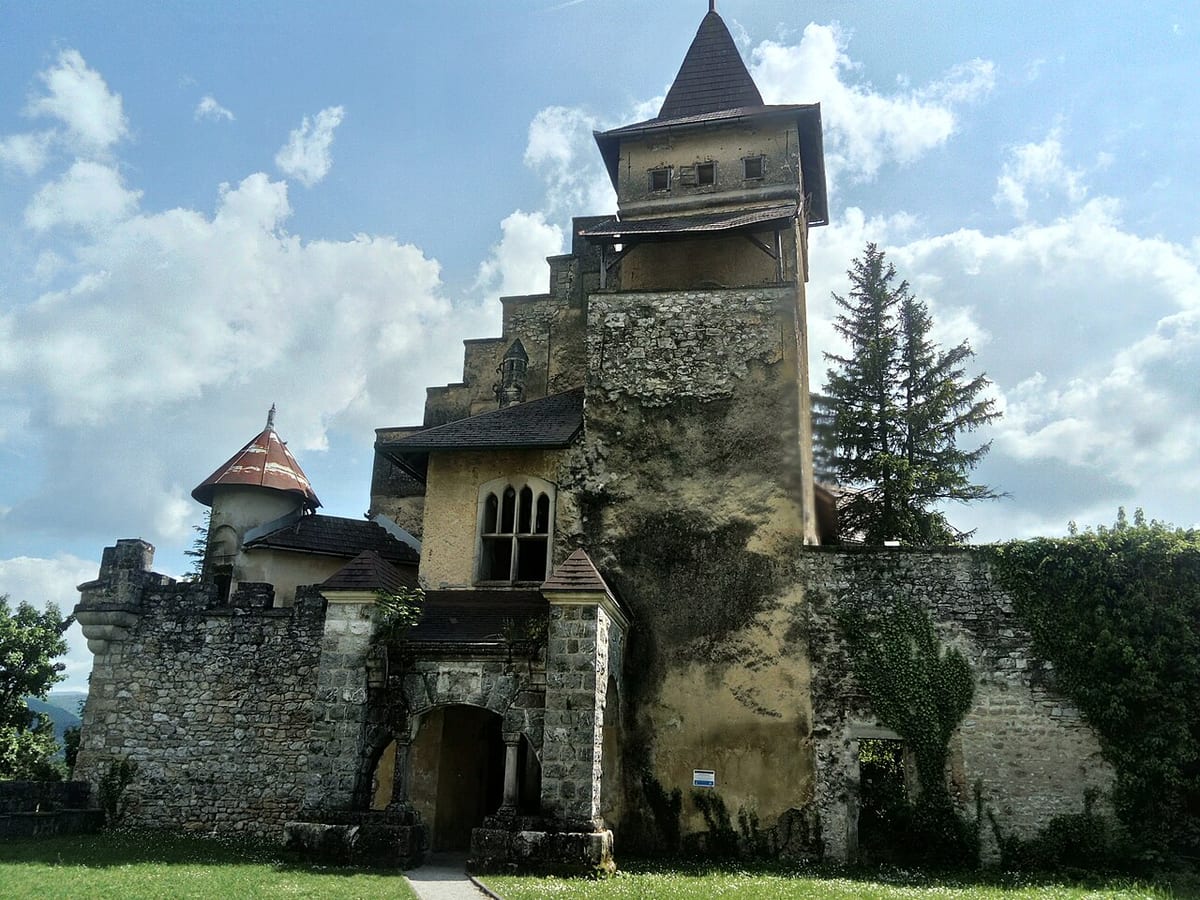
Ostrožac combines a medieval stronghold with later Ottoman expansion and a much younger residential complex.
Location
Cazin · Una Valley
Local name
Stari grad Ostrožac
Historical period
Documented 1321
Ostrožac stands above the Una valley in Bosanska Krajina, where its position helped control a route and its hinterland. The Museum of the Bosnian Kingdom identifies a document of 1321 as the first reliable written evidence, a useful distinction from earlier dates repeated in popular accounts. Medieval ownership connects the site to the Babonić family and the princes of Blagaj, with a period under Vuk Vukčić Hrvatinić. Ottoman control became established in 1578 and brought further expansion. The striking palace within the walls belongs to a much later chapter: Lothar von Berks added a neo-Gothic residence. Reading the complex means separating these layers. Its picturesque palace silhouette should not be mistaken for the appearance of the entire fortress in the medieval period.
The 1321 record concerns a purchase by the princes of Blagaj before the Zagreb Chapter. Royal confirmation followed in 1330. These transactions establish that Ostrožac already existed; neither supplies the date when its first walls were built.
Sigismund transferred the fortress to Vuk Vukčić Hrvatinić after confiscating it from the Babonići. Later it returned to Babonić control. Such changes connected the Una valley with wider struggles over royal authority, noble estates and campaigns against Bosnia.
Ostrožac’s medieval story also belongs to its townspeople. The museum identifies an early-fifteenth-century municipality led by a judge named Smolac, and a partly preserved seal on a document of 1403. A crowned tower formed the seal’s central image. This is a different kind of evidence from a surviving wall: it shows how a community represented itself in writing. The settlement associated with the fortress accommodated crafts and trade. When looking across the enclosure, imagine those legal and economic relationships as well as the garrison, without treating the much later neo-Gothic residence as their medieval setting.
First reliable written evidence identified by the Museum of the Bosnian Kingdom.
1578
Ottoman forces establish control of Ostrožac.
Berks period
A neo-Gothic palace adds a later residential layer within the fortress.
Architecture & evidence
Eastern defense tower
The circular defense tower and gate belong to the eastern fortified nucleus. The long enclosure later extended westward.
Berks residence
The western neo-Gothic residence gives Ostrožac its distinctive silhouette. Steep roofs and stepped gables contrast with the older defensive walls; individual rooms and elevations here are interpreted.
Sculpture-park grounds
The open courtyard is also the setting for Ostrožac’s modern sculpture park. The model shows the grounds without inventing replicas of individual artworks.
Plan your visit
Cazin’s Centre for Culture and Tourism publishes visitor information for Ostrožac and handles ticket enquiries or specific requests through info@ckt.ba and +387 37 539 069. Confirm your intended date and any access needs with the centre before travelling. Its guidance lists Ostrožac separately from the old town in central Cazin: a statement that entry to Old Town Cazin is free should not be read as an Ostrožac ticket policy.
A first written mention is not necessarily a construction date. Fortresses were often altered over several centuries. Sections link to their supporting references; the 3D model is an interpretation, not evidence of every historical phase.
Ostrožac's courtyard contains work made centuries apart. Medieval records, Ottoman building campaigns, the Berks residence and the sculpture colony explain how such different uses came to share one enclosure.