
Vranduk, Maglaj and Doboj on the Bosna river
Three fortresses in the Bosna valley stood beside routes used by traders, townspeople and armies. Their histories extend into the settlements and approaches below the walls.
Zenica · Bosna Gorge · Documented 1410
Vranduk was both a royal meeting place and a fortified settlement controlling the Bosna corridor.
Vranduk occupies a strategically important position in the Bosna valley north of Zenica. The city museum dates its probable beginnings to the late fourteenth century and records its first written mention in 1410. This was more than a lookout: Bosnian rulers received envoys, issued charters and concluded agreements here. Its history also includes the communities outside the walls, including the trading and craft settlement at Varošišće. King Tomaš invested in the town and its defences during the fifteenth century. Ottoman capture in 1463 opened another long period of use, followed eventually by Austro-Hungarian occupation. The fortress now belongs to the Zenica City Museum's network of sites. Its compact walls make most sense when understood together with the river corridor and surrounding inland hills.
Explore the 3D model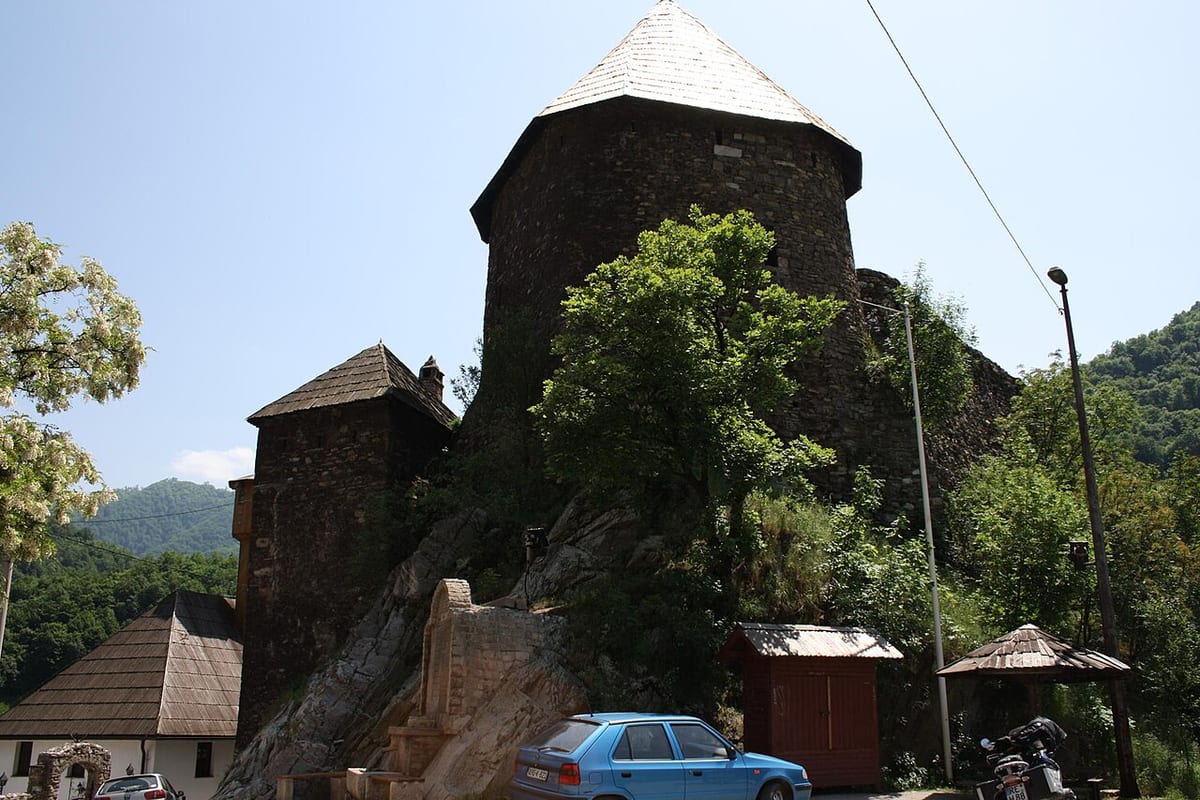
The main tower was once taller, and a wall divided the courtyard. The small tower and eastern wall were later additions protecting the entrance. Remains identified as the dizdar’s house show that command and accommodation belonged within the defensive circuit.
Pottery, jewellery, coins, tools and spurs recovered here are kept by Zenica’s museum. They broaden the story beyond royal charters. The fortress later served as a prison and held an Austro-Hungarian garrison before abandonment in 1890.
Not all of medieval Vranduk’s activity fitted into its tight enclosure. Zenica’s museum places a larger trading and craft settlement at Varošišće, about two and a half kilometres away, where Franciscans established a monastery and a church of St Mary. This separation is important: the compact stronghold and its surrounding economic landscape were related, but were not the same built space. Compare the narrow fortified position with the valley around it. The contrast offers a way to understand how a royal meeting place depended on settlements, religious institutions and movement along the Bosna corridor.
The name Vranduk enters the written record.
Ottoman forces take the fortress.
Austrian troops occupy the site before the garrison leaves.
The designation records an approximately 9.25 m square exterior and a wooden shingle roof. The museum explains that the tower was taller in the medieval period. This model shows the roofed surviving form; its total height is estimated.
The unusually small entrance is recorded as 0.82 m wide and about 1.70 m high. A smaller tower and an additional eastern wall strengthened its defense. The model leaves a real opening through the curtain.
The designation describes a filter cistern with a central 2.5 m bore. Its rim is shown in the long, narrow courtyard; underground filtration layers are omitted.
For Vranduk, use the fortress visitor information from Zenica City Museum rather than the opening hours of its city-centre building. The museum’s published pages give different seasonal schedules, and its tariff page notes a winter closure. Confirm your date, ticket price and any guided arrangements with the museum on +387 32 209 515 or zemuzej@bih.net.ba. This is especially useful when combining the fortress with the separate Bosnian House exhibition.
Published guidance checked . Not checked on site; confirm current arrangements with the operator before travelling.A first written mention is not necessarily a construction date. Fortresses were often altered over several centuries. Sections link to their supporting references; the 3D model is an interpretation, not evidence of every historical phase.
Three fortresses in the Bosna valley stood beside routes used by traders, townspeople and armies. Their histories extend into the settlements and approaches below the walls.
Travnik · Lašva Valley
Varošluk · Turbe
Vareš · Central Bosnia